
Introduction
Successful dental implant treatment begins long before the implant is placed.
Your dentist needs to understand the condition of your jawbone, the position of nearby structures, and how the implant should be positioned to support the final restoration.
Traditional two-dimensional X-rays provide useful information, but they cannot always show the complete picture.
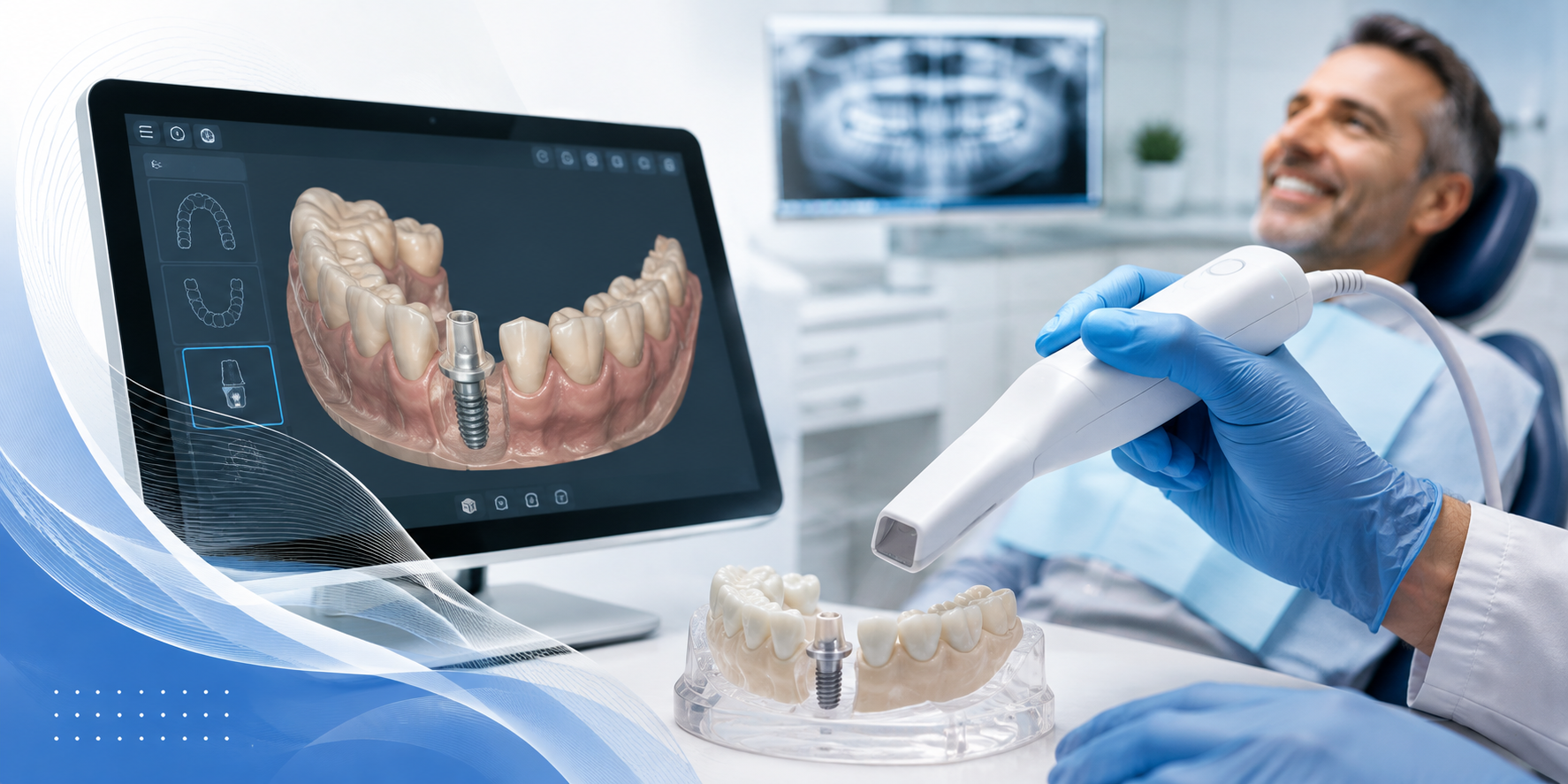
That is where 3D dental imaging can make a difference. A three-dimensional scan gives dentists a much more detailed view of the structures involved in implant treatment.
If you are planning to get dental implants in Pickering, this information can be used to plan the procedure more precisely, identify potential challenges early, and create a treatment approach based on your individual anatomy.
What Are 3D Dental Scans?
A 3D dental scan, commonly produced using cone beam computed tomography (CBCT), creates detailed three-dimensional images of the mouth and jaw.
Unlike a standard dental X-ray, which produces a flat image, a 3D scan allows the dentist to examine the jaw from different angles. This can provide valuable information about bone structure, tooth roots, nerves, sinuses, and other anatomical features.
For dental implant treatment, this detailed information can help the dentist understand whether there is sufficient bone available and determine where an implant can be positioned safely.
How 3D Scans Improve Dental Implant Treatment
1. Provide a Detailed View of the Jawbone
Dental implants need adequate bone support to remain stable. A 3D scan allows the dentist to assess the height, width, and overall structure of the available bone.
This is particularly important for patients who have experienced bone loss after tooth loss. The scan can help identify areas where bone volume may be limited and whether additional treatment may be required before implant placement.
Instead of relying on estimates, your dentist can use detailed digital images to understand your individual bone anatomy.
2. Help Dentists Plan Implant Placement More Precisely
The position of an implant can affect its stability, function, and the appearance of the final restoration.
3D imaging allows the dentist to plan the implant’s position, angle, and depth based on the surrounding anatomy. Digital planning can help identify the most appropriate location before the procedure begins.
This level of planning is especially valuable when the available bone is limited, or the implant site is close to important anatomical structures.
3. Show the Location of Important Nerves
Important nerves run through parts of the jaw. Their location needs to be carefully considered during implant planning.
A 3D scan can help the dentist visualize these structures and plan implant placement while taking their position into account.
This additional information can improve treatment planning and help reduce avoidable risks associated with positioning the implant too close to sensitive anatomical structures.
4. Help Assess the Sinuses
For implants in the upper back jaw, the position of the maxillary sinus can be an important consideration.
A 3D scan allows the dentist to evaluate the relationship between the planned implant site and the sinus. This can help determine whether there is sufficient bone and whether additional procedures may need to be considered.
Understanding the anatomy beforehand allows the treatment plan to be developed with greater confidence.
5. Identify Potential Problems Before Treatment
A detailed scan can reveal anatomical or dental factors that may not be obvious during a standard examination.
Your dentist may identify areas of bone loss, impacted teeth, infections, unusual anatomy, or other conditions that could affect implant treatment.
Finding these issues before surgery allows the dental team to address them or modify the treatment plan where necessary.
6. Support More Predictable Treatment Planning
Dental implant treatment involves several stages, from assessment and planning to implant placement and final restoration.
3D imaging provides information that can be used throughout the planning process. The dentist can evaluate the implant site, consider the planned restoration, and develop a treatment approach that accounts for your specific anatomy.
Better information before treatment can contribute to a more predictable overall process.
7. Help Determine Whether Bone Grafting May Be Needed
Some patients do not have enough bone volume to support an implant immediately.
A 3D scan can help the dentist assess the available bone and determine whether bone augmentation or another preparatory procedure may be appropriate.
This allows patients to understand potential treatment requirements before implant placement rather than discovering a limitation during the procedure.
What Happens During a 3D Dental Scan?
A 3D dental scan is generally quick and non-invasive. The patient is positioned in the imaging unit while the scanner captures detailed images of the teeth and jaw.
The scan itself does not require an incision or injection. Once the images are captured, the dentist can review them digitally and use the information to plan treatment.
Your dentist will explain what the scan involves and whether any specific preparation is required before the appointment.
Are 3D Dental Scans Safe?
Dental 3D imaging uses radiation, so it should only be used when clinically appropriate. CBCT systems are designed to capture the information required for diagnosis and treatment planning while using a limited field of view when appropriate.
Your dentist will determine whether 3D imaging is necessary based on your individual treatment needs.
Can 3D Scans Make Dental Implant Treatment Faster?
3D scans do not automatically make every implant procedure faster. Their main benefit is providing detailed information that can improve treatment planning.
By identifying anatomical challenges and determining the appropriate implant position before treatment, 3D imaging can help the dental team prepare more effectively and reduce unexpected issues during the procedure.
The overall treatment timeline still depends on factors such as bone health, healing, the number of implants required, and whether additional procedures are needed.
Are 3D Scans Useful for Everyone Getting Dental Implants?
Not every implant patient requires exactly the same type of imaging. Your dentist will determine which diagnostic tools provide enough information for your specific situation.
For more complex implant cases, however, three-dimensional imaging can provide valuable information that may not be available through conventional X-rays alone.
A More Precise Path to Dental Implants
3D dental scans have become an important tool in modern implant dentistry because they provide a detailed view of the anatomy that supports treatment planning.
By helping dentists evaluate bone structure, identify nerves and sinuses, assess potential challenges, and plan implant positioning, 3D imaging can make the treatment process more informed and predictable.
If you are considering dental implants in Pickering, Allure Dental can assess your individual needs and determine whether advanced imaging and digital planning are appropriate for your treatment.
At Allure Dental, we combine modern digital technology with personalized care to help make your implant journey as smooth, accurate, and predictable as possible.
Every treatment plan is tailored to your oral health, smile goals, and long-term function, ensuring you receive care that’s right for you.
Schedule your consultation today and let our experienced team help you restore your smile with confidence.
FAQs
Why are 3D scans used for dental implants?
3D scans provide detailed information about the jawbone, nerves, sinuses, and surrounding structures. Dentists can use this information to plan implant placement more accurately.
Are 3D scans better than regular dental X-rays for implants?
They provide different levels of information. Standard X-rays are useful for many dental assessments, while 3D scans provide a three-dimensional view that can be particularly valuable for implant planning.
Do I need a 3D scan before getting dental implants?
Not every patient requires the same imaging. Your dentist will determine whether a 3D scan is appropriate based on your anatomy, treatment complexity, and implant needs.
Can a 3D scan show if I have enough bone for a dental implant?
Yes. A 3D scan can help the dentist evaluate the available bone and identify areas where bone volume may be insufficient for immediate implant placement.
Can 3D scans show nerves before dental implant surgery?
Yes. Three-dimensional imaging can help dentists identify the location of important nerves and other anatomical structures when planning implant placement.
Are 3D dental scans painful?
No. The scanning process is non-invasive and does not involve injections or incisions. The patient simply needs to remain still while the images are captured.
How long does a dental 3D scan take?
The actual scan is generally completed quickly, although the overall appointment time can vary depending on the imaging equipment and your treatment consultation.
Do 3D scans reduce the risks of dental implant treatment?
3D imaging provides more detailed information for treatment planning, which can help the dentist identify anatomical structures and potential challenges before treatment. However, no imaging technology eliminates all risks associated with dental procedures.
Can 3D scans help with dental implants in Pickering?
Yes. When clinically appropriate, 3D imaging can help dentists plan implant treatment based on the patient’s individual jaw anatomy, whether they are seeking dental implants in Pickering.
Can a 3D scan tell me if I need a bone graft?
It can help your dentist assess bone volume and determine whether there may be insufficient bone for implant placement. Your dentist will then decide whether bone grafting or another treatment is appropriate.